

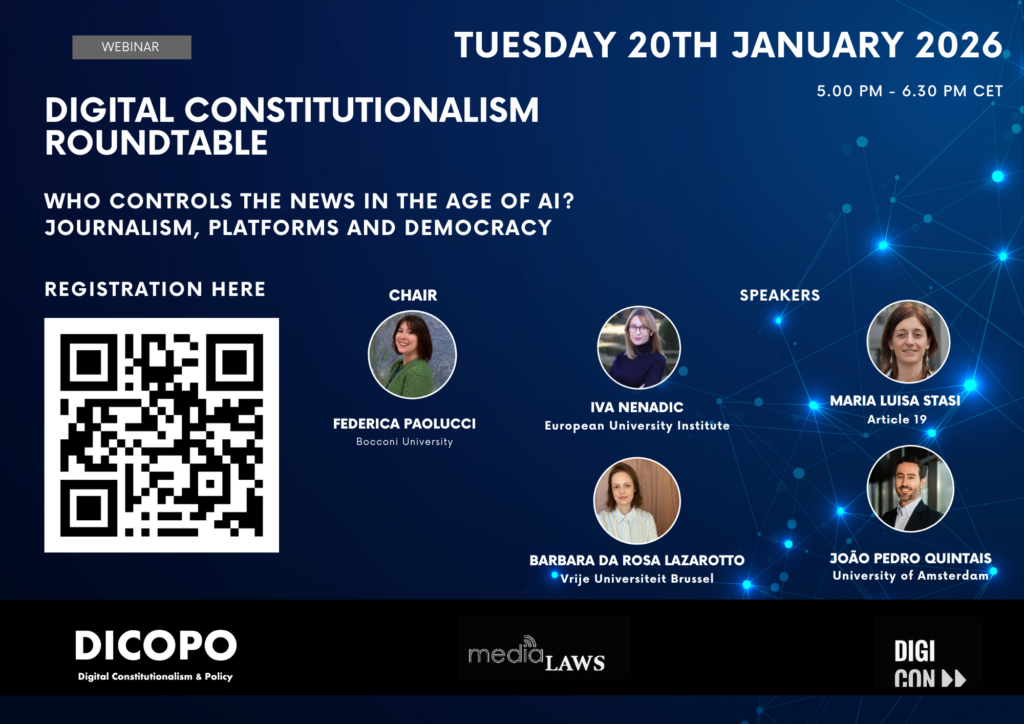
The roundtable “Who controls the news in the age of AI”, hosted by MediaLaws, DICOPO and DigCon, brought into sharp focus a central issue of our time: how the governance of AI-mediated information reshapes democratic structures, media pluralism, and constitutional values.
Joao Quintais, University of Amsterdam, highlighted the evolving role of gatekeepers in the AI-driven information ecosystem and the consequences this has for democracy. His intervention explored the complex intersections between the AI regulatory framework and the Digital Services Act, with particular attention to licensing agreements and revenue-sharing models between platforms and publishers. These mechanisms, while often presented as pragmatic solutions, raise deeper questions about normative coherence, regulatory simplification, and the redistribution of power within the information value chain.
Iva Nenadić, European University Institute, framed the discussion around the concept of media pluralism and its normative foundations. She emphasised how architectural choices, structural dependencies, and systemic risks associated with AI systems are contributing to a profound structural transformation of the public sphere. This transformation affects not only information flows but also the autonomy and authority of journalism itself, undermining its democratic watchdog function.
Maria Luisa Stasi, Article 19, addressed the issue of digital dependency, focusing on the widespread reliance on cloud infrastructures. While cloud services promise efficiency and security, they also introduce new forms of structural dependency that influence agency, editorial independence, and the very conditions under which news is produced and distributed.
Barbara Da Rosa Lazarotto, Vrije Universiteit Brussel, examined the claims raised in the dispute between FIEG and the AI Overview product by Google before AGCOM. Beyond the measurable impacts, such as reductions in traffic and advertising revenues, she underscored a broader democratic concern: the erosion of sustainable economic models for journalism directly affects the resilience of democratic discourse.
Across all interventions, a common thread emerged: AI does not merely disrupt the media sector: it reconfigures power, dependency, and accountability within the democratic public sphere, and trust by the people. The challenge ahead is not only regulatory, but constitutional: ensuring that innovation does not come at the expense of pluralism, autonomy, and democratic governance of information.
To rewatch the video, click here: Who controls the news in the age of AI.